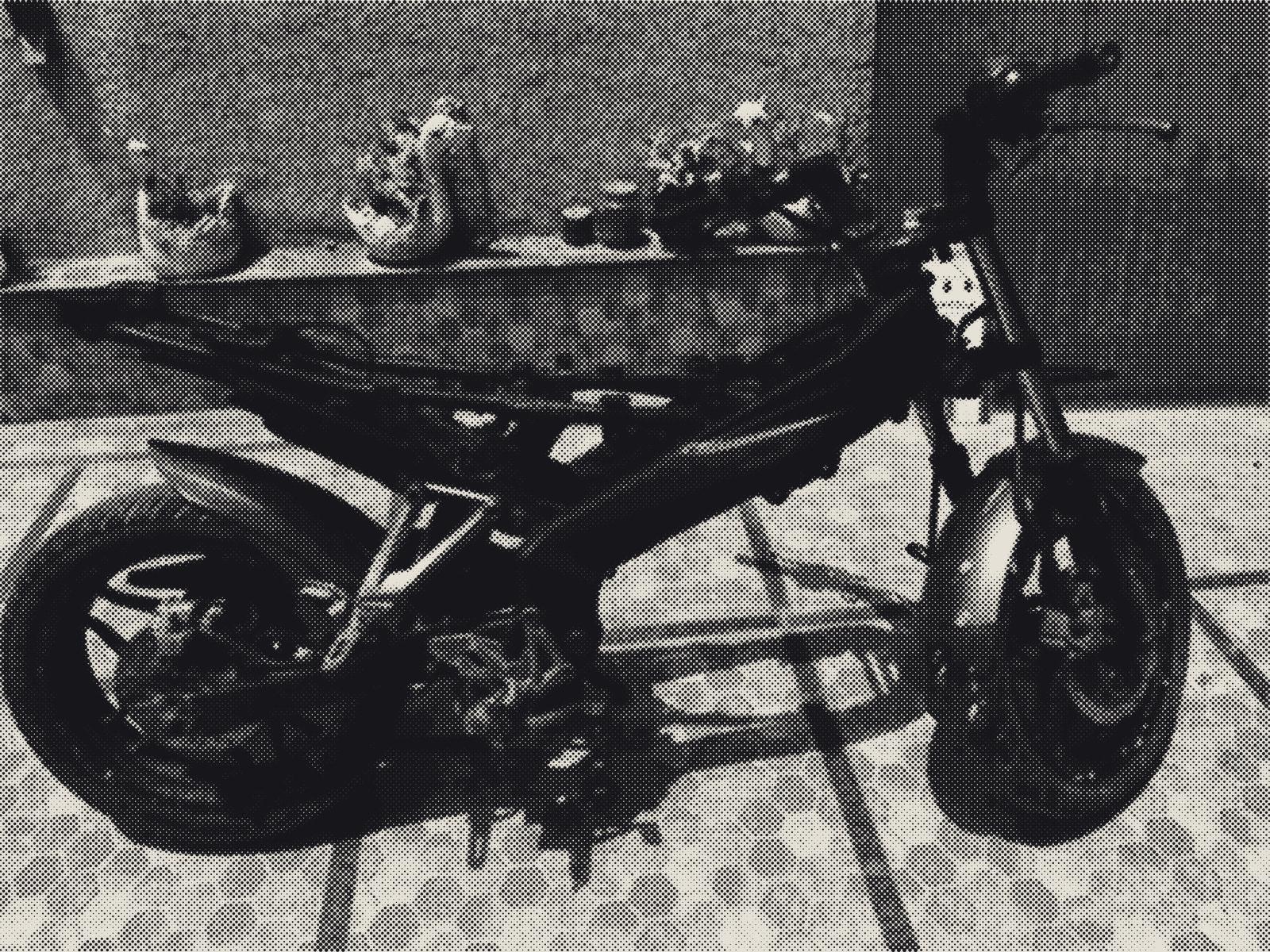
Jaipur — the resurrection
For a few weeks this summer my weekends had a theme: wander through the automobile scrap markets of Jaipur and stare at dead motorcycles. If you have never done this, I recommend it. It is very peaceful and everyone thinks you are up to something.
Eventually I found my guy. Every scrap market has one — the person who doesn’t blink when you explain something ridiculous. He rolled out a dead Bajaj Pulsar NS200, and I told him exactly what I wanted: not the bike, just the frame, cut and kept the way I needed it. A few days later I came back and it was waiting for me, stripped down to the bones.
I also went home with a small hoard of parts I had no immediate use for — a bracket here, an odd bit of trim there, things I bought purely because they looked like they belonged on something cool. Every good project needs a drawer of things you can’t justify yet.
Getting the frame home was its own small saga. We tied it upright inside an e-rickshaw, and I folded myself into the sliver of space beside the driver, one hand on the frame the whole way, the two of us puttering across the city like I was escorting a very important, very dead motorcycle. Nobody stopped us. Honestly, a little disappointing.
Back at the workshop I pulled off the leftover bodywork it had arrived with — the cracked panels, the sad remains of whatever life it used to have. Then I tried to clean the frame myself. This was optimistic. Years of road grime and engine grease had fused into a coating that looked at my rag and laughed. So I did the only reasonable thing a person can do: I rolled a dead motorcycle frame about a kilometre down the road, in the full afternoon sun, to a bike cleaner who could do in twenty minutes what I couldn’t do in an afternoon. People looked. I waved.
Then came the good part.
For a stretch of nights I just sat in front of the bare frame with a pencil, a sketchpad, and AC/DC turned up, and drew. Panels, cowls, the shape of the tank cover, the stance I wanted the thing to have. I fell into every rabbit hole the internet offers — Pinterest boards, other people’s builds, and a genuinely unreasonable amount of time spent circling bikes parked on the road, walking around them slowly like I was appraising a horse. Slowly a rough design started to appear on paper.
Here’s the part I’m most excited about, and the reason the frame matters more than anything that’ll bolt onto it. I don’t want to build one bike. I want to build one core bike that can wear different bodies. A scrambler one week, a café racer the next, maybe something sharp and sporty after that — same machine underneath, different personality on top, swapped out like changing a jacket. The first outfit is a scrambler.
Right now all of this lives half on paper and half on my laptop, where I’m turning the pencil sketches into 3D models. I’m printing the early versions in cheap PLA on my Bambu Lab P1S — not the final material, just fast throwaway prototypes to find out whether my measurements are honest and whether my mounts actually kiss the frame instead of floating a centimetre off it in real life. (They rarely line up on the first go. That’s the entire reason you print the cheap version first.) The real panels will eventually come out in ASA-CF, which copes with sun and heat far better than PLA, whose one great weakness is going soft the moment it remembers it’s summer in Rajasthan.
I’ve also picked up a pair of foglamps headed for the headlight cowl, and I’ve started poking at the electronics.
Now — the responsible way to build an electric bike is probably to sort out the motor and battery first. You know. The parts that make it move. I am doing the exact opposite: bodywork and electronics now, drivetrain later. The deeply technical reason for this is that motors and batteries are expensive and my bank account holds strong opinions. So the plan is at least honest: make it beautiful, make it wired, and make it actually go — in that slightly backwards order.
For now it’s a clean bare frame in a workshop, ringed by pencil sketches and PLA prototypes, waiting to find out what it’s going to be. Which, after the life it’s had, feels like a fair deal.
More when there’s more.